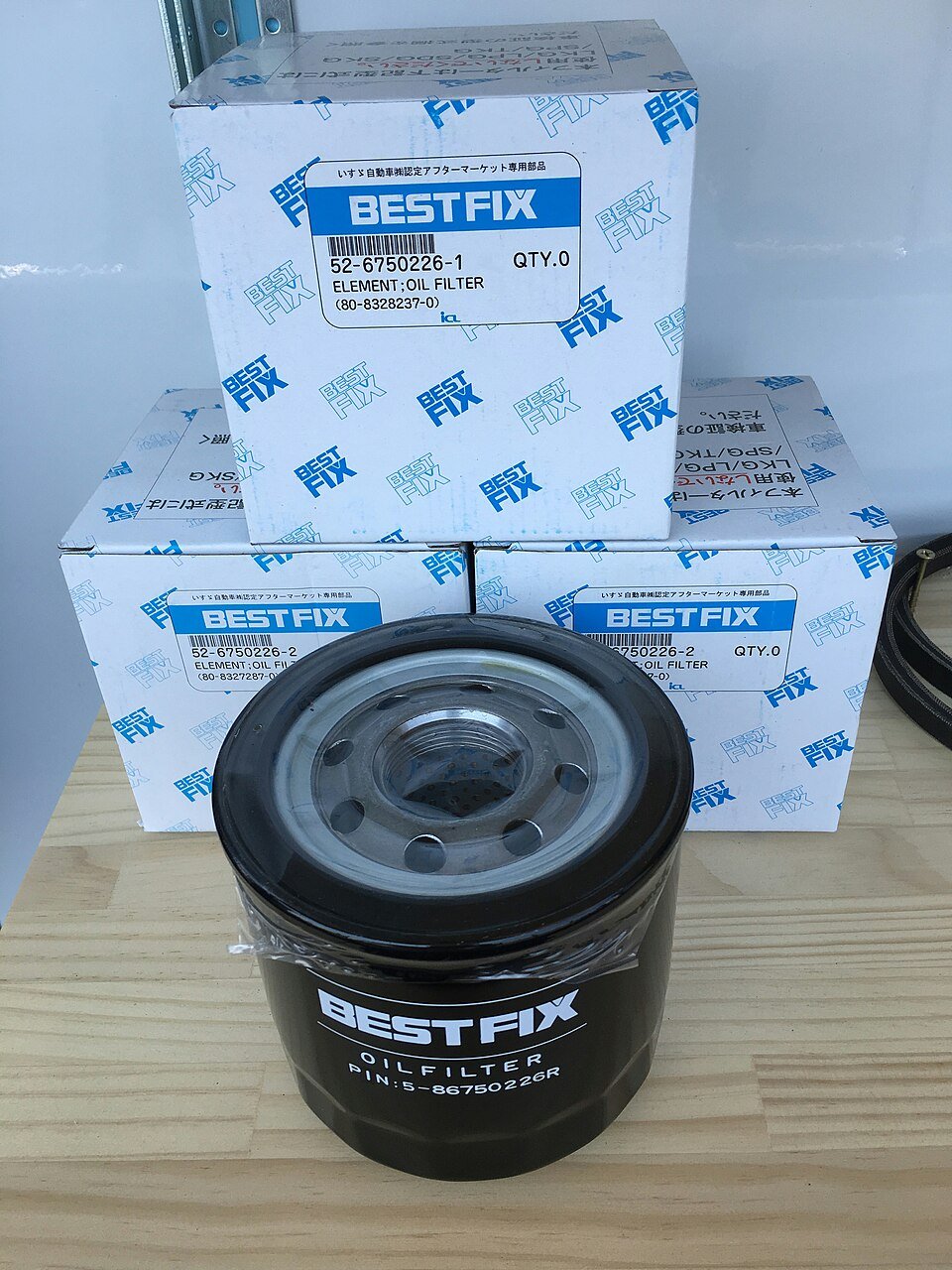
Ask a fleet owner in Nigeria, the DRC or Iraq what fails most often on their excavators and fuel filtration usually comes up before anything mechanical. That is not because the elements are bad — it is because the diesel arriving at site is often carrying water, fine sediment and, in hot humid climates, microbial sludge that turns a clean fuel tank into a contamination source. The element then does exactly what it is designed to do and blocks up early, and the operator blames the filter. This guide covers what actually kills fuel filters on excavators, how to read the symptoms before they cost you an injection pump, and the verified part numbers for the two machines that dominate the used fleet — the Cat 320D and the Komatsu PC200.
1. What Actually Kills an Excavator Fuel Filter
Fuel filter failures are a contamination story almost every time. Four things do the damage, and they usually arrive together:
| Cause | What you see | What it does |
|---|---|---|
| Water in the diesel | Separator bowl filling fast, cloudy or rusty fuel, corrosion in the tank | Water passes into the filter media, swells the paper and strips its dirt-holding capacity — the element both blocks and loses efficiency |
| Sediment and dirt | Rust-coloured sludge in the separator, element turning black on the outside | Fills the pleats from the outside in, raising restriction until the transfer pump cannot hold pressure under load |
| Microbial growth ("diesel bug") | Dark slime in the tank and separator, sour smell, filter blocking within days of fitting | Grows at the water/fuel interface in hot, humid conditions and sheds sludge continuously into the fuel line |
| Wrong or mis-matched element | Element that fits but never reaches normal service life, or leaks at the seal | A cross-reference that is close but not the same element has the wrong media area, thread or seal — it either bypasses dirt or blocks early |
Note what is missing from that table: "cheap filters". A quality aftermarket element with correct media is not the failure mode. The failure mode is contamination plus a separator that is not being drained, and it is why the machines that suffer most are the ones working in dusty environments with fuel delivered in drums or from small roadside stations.
2. The Five Symptoms, in the Order They Appear
A restricted fuel filter almost never fails without warning — it gives you a sequence of signals first. Reading them in order is how you replace a $20–60 element instead of a pump or a set of injectors:
- Power loss under load, normal at idle. The classic first sign. At low flow the element passes enough fuel; under digging load the engine starves and the machine feels flat or derates.
- Longer cranking and hard starting. Restriction lets air into the system and drops pressure at the injection pump, so the engine needs extended cranking or re-priming.
- Smoke and rough running. Combustion changes as delivery pressure drops — expect black or white smoke, hunting idle and a note that changes under load.
- Elements that do not reach their interval. If you are changing fuel filters twice as often as the service schedule says, the fuel is dirty or the separator is not doing its job. That is a fuel-quality problem, not a filter problem.
- Pump and injector damage. The expensive stage. On common-rail and unit-injector engines, water and fine abrasive particles that get past a saturated element wear precision components — a repair that costs many times the price of a year of elements.
3. Two Elements, Two Jobs: Filter vs Water Separator
The single most common service mistake we see is treating the water separator as an optional extra, or replacing one element and not the other. They are doing different jobs and they fail in different ways:
| Fuel/water separator element | Main fuel filter element | |
|---|---|---|
| Position | First stage — ahead of the main filter | Second stage — final protection before the injection pump |
| Job | Coalesces water droplets so they settle in the bowl, and catches the bulk of sediment | Traps the fine particles the separator lets through, typically down to 2 microns on advanced-efficiency elements |
| Service rhythm | Water drained regularly; element replaced on the machine's schedule or when contaminated | Replaced at the fuel-service interval, and whenever restriction symptoms appear |
| If neglected | Water reaches the main element, which blocks early and can pass water into the pump | Restriction, power loss and eventual injection-system damage |
Two habits matter more than any brand choice. First, drain the separator — on these machines a daily drain is standard practice in dusty or humid conditions, and your machine's Operation and Maintenance Manual gives the interval for your build. Second, change both elements as a pair: the separator that stays in service while the main filter is renewed is usually the worn part that caused the problem.
4. Verified Part Numbers for the Two Highest-Volume Machines
The machines below dominate the used fleets we supply parts for across Africa, the Middle East and Latin America. These numbers are cross-checked against Cat and Komatsu parts references and aftermarket fitment listings (September 2026) — but the rule never changes: order by the number stamped on the element you are removing, plus your machine serial.
| Machine | Fuel filter element | Water separator element |
|---|---|---|
| Cat 320D / 320D L / 320D GC (C6.4) | 1R-0751 | 326-1644 (supersedes 1R-0770) |
| Cat 320D, MZD-prefix builds | 364-5287 | 438-5386 (per Cat 320D parts reference guide) |
| Cat 320B / 320C / 322C / 323D L / 325C L family | 1R-0751 (aftermarket fitment lists) | 326-1644 (aftermarket fitment lists) |
| Komatsu PC200-8 / PC220-8 (SAA6D107E) | 600-311-8321 | Confirm by serial / machine number |
| Komatsu PC200-7 / PC200-6, PC220-7, PC300-7 | 600-311-9121 (fuel filter / water separator with drain) | Integrated in the 600-311-9121 element on this generation |
Cross numbers, for when you are buying locally and need to check what you are being offered:
- 1R-0751 — Fleetguard FF5324 (FF5309 and FF5321 appear on some lists), Baldwin BF7632 (BF7530MPG, BF7634), Donaldson P551315, WIX 33377/33626, NAPA 3377/3626, Fram P8264/P8451/P8490. Cat numbers 1R-0759 and 6I4783 appear on the same fitment lists.
- 326-1644 — Baldwin BF1284-SP, Donaldson P550626 / P551110, Sakura FS19820; 326-1643 is the filter assembly the element fits.
5. The Traps That Send the Wrong Element
Both machines have a near-neighbour part number that looks right on a listing and is wrong on the machine:
- 1R-0750 vs 1R-0751 (Cat). Same family, same 2-micron media, different thread and different engine class. The 1R-0750 is the 1"-14 element for C10–C18 engines and the 330D/336D machines; the 1R-0751 is the 7/8"-14 element listed for the 320D's C6.4 and the wider 3116/3126/C6.6/C7/C9 family. Our 1R-0750 page and 1R-0749 page cover exactly which machines those fit.
- 600-311-9121 vs 600-311-8321 (Komatsu). The 9121 is the -6/-7 generation element (SAA6D102E era, with drain); the 8321 is the PC200-8 main fuel filter. Fitting the wrong one means an element that threads on but does not seat or seal correctly.
- Supersessions are not mistakes. 326-1644 replacing 1R-0770, or 134-0685 appearing alongside the 131-8822 air element on 320D listings, are normal number changes across production. A genuine red flag is a seller quoting a number from a different engine class — see how to spot fake filters for the physical checks that go with a number check.
For the complete filter list on both machines, see the Cat 320D filter guide and the Komatsu PC200-8 filter guide; for the generational split on Komatsu's 20-tonne class, see PC200-7 vs PC200-8. Everything listed here is available through our filters catalogue and the parts catalogue.
FAQ
Q: Why does my excavator clog fuel filters so often?
A: In almost every case the filter is not the problem — the fuel is. Water, fine sediment and microbial sludge that arrive with low-quality diesel load the element far faster than clean fuel would, and if the water separator ahead of the fuel filter is not drained, the main element ends up doing both jobs. Buy the element by its OEM number, keep the separator drained, and change the fuel filter and separator element together rather than one at a time.
Q: What are the symptoms of a clogged fuel filter on an excavator?
A: The usual pattern is progressive: power loss under load but normal idle, longer cranking because air or low pressure is reaching the injection pump, changing exhaust smoke, and eventually derating or a stall that needs re-priming. On common-rail and unit-injector engines a restricted element also pushes the pump and injectors harder — which is why the element is far cheaper than the components it protects.
Q: Which fuel filter and water separator does a Cat 320D take?
A: Cat's 320D parts reference guide lists the 1R-0751 fuel filter element and the 326-1644 fuel/water separator element for the standard 320D, 320D L and 320D GC (C6.4 engine). The 326-1644 supersedes the earlier 1R-0770 element listed for the same machine. MZD-prefix 320D builds list different fuel-side numbers (364-5287 and 438-5386), so confirm against your old element and machine serial.
Q: Is the 1R-0750 fuel filter the same as the 1R-0751?
A: No. Both are 2-micron advanced-efficiency Cat fuel elements of similar size, but the 1R-0750 is the 1"-14 threaded element for the C10–C18 engine class (including 330D/336D machines), while the 1R-0751 is the 7/8"-14 element listed for the 320D's C6.4 engine and the wider 3116/3126/C6.6/C7/C9 machine family. They are not interchangeable — match the number stamped on the element you are removing.
Buying Fuel Filters and Separators for Your Fleet?
Send your machine model, serial and a photo of the old elements — we confirm the correct numbers, quote within 24 hours and ship with your next parts order.
Chat on WhatsApp Email sales@cn-machinery.com